Wu Mei Symbols
Wu Mei Plum Blossom Logo
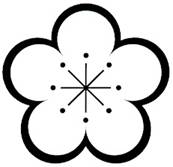 The five petals of the Wu Mei Pai logo represent the five
extremities - head, two arms, and two legs, their movement ranges, and the five
elements (Wu Hsing) - metal, earth,
fire, water, and wood. These elements have
creation and destruction orders that are a model for martial strategy. The eight stamens represent the eight
trigrams of the I Ching (Book of
Changes) and eight directions.
The five petals of the Wu Mei Pai logo represent the five
extremities - head, two arms, and two legs, their movement ranges, and the five
elements (Wu Hsing) - metal, earth,
fire, water, and wood. These elements have
creation and destruction orders that are a model for martial strategy. The eight stamens represent the eight
trigrams of the I Ching (Book of
Changes) and eight directions.
The
stamens are equal in length from the center, representing Wu Mei Pai's principle
of force in all directions. The small
dots at the end of the stamens represent the release of force out of the
extremity but still within the range of movement.
The
plum blossom blooms in the winter and appears without leaves. This flower therefore represents strength
under adversity. It is the national
flower of Nationalist China in
Performance
Space Layout
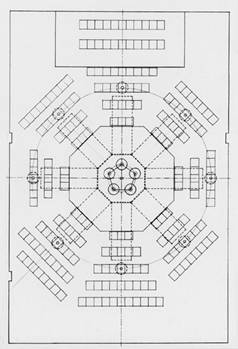 The design of the 25th Anniversary performance
space is a result of the confluence of Eastern and Western architectural and
philosophical concepts. The primary
elements of the design spring directly from the symbol of Wu Mei Pai, the Plum
Blossom. This symbol in turn embodies
and signifies a number of meanings, which have been previously discussed.
The design of the 25th Anniversary performance
space is a result of the confluence of Eastern and Western architectural and
philosophical concepts. The primary
elements of the design spring directly from the symbol of Wu Mei Pai, the Plum
Blossom. This symbol in turn embodies
and signifies a number of meanings, which have been previously discussed.
An
arena/theater in the round configuration for the demonstration area was chosen
as an expression of the spatial nature of the Wu Mei forms. In these forms, the player moves through
space in all directions, and faces in all directions. No single direction or heading is favored; no
location in the auditorium has a position of privilege for viewing the
forms. Instead, through the continuously
changing movement of the player, the audience is able to observe this kinetic,
spatial art form from many viewpoints.
In turn, the player is reminded of the infinite possibilities of
movement in three-dimensional space.
The
materials used in the design of the space are purposefully selected for their lightness and flexibility.
This allows various elements of the design to become subject to the
movement of the players, the audience, and the environment. The ‘Ba Gua’ canopy provides a field on which
to read movement by way of light and air.
The ‘Plum Blossom’ lanterns present a luminous origin from which
potential is realized. Combined, these
elements define a center while reaching out to embrace the extremities of the
entire space, and to draw all occupants together in a shared experience.